.png)
Commercial property has a multitude of use cases, and with every site comes different revenue, costs, priorities and standards.
Each property is comprised of commercial assets that all have a life cycle. Whether that’s the roof, brick, siding, equipment, lighting, drainage, and of course, your parking lot and pavement surfaces.
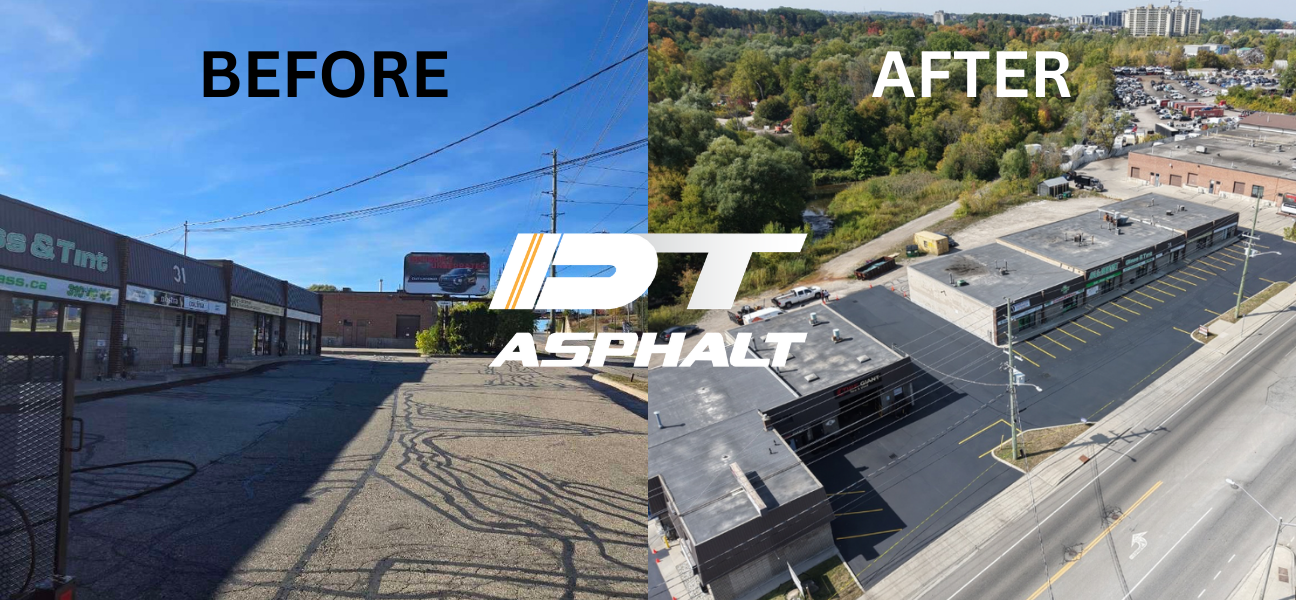
Every asset has different maintenance requirements. Some you hardly touch, some need consistent service, and some can quietly drain serious capital if they’re ignored too long.
I’m not here to tell you how to maintain the rest of your building. I’m not an expert in roofing, HVAC or envelope systems.
What I am an expert in is pavement preservation.
Not just “filling potholes” and “painting the lines,” but proactively protecting your lot from the harsh elements here in Canada that can absolutely tear apart a six or seven figure pavement asset over time.

If your goal is to keep what you have in good shape and not burn through capital like it grows on trees, this article is for you.
I’m going to show you how pavement deteriorates, why it happens, how to slow it down properly, and why so much money gets wasted in this industry by people doing maintenance the wrong way.
There’s no shortage of opinions and bad advice in this business.
Most property managers I talk to are advised by the same paving company that paved their lot. I understand the logic. You’d think they would have your best interest in mind, and you’d think they’d understand how to maintain asphalt.
But there is a direct conflict of interest there.
They get paid to pave. A lot of paving companies have millions invested in paving equipment, trucks, plants, crews and overhead. Their model is built around large production work. Maintenance doesn’t move the needle for many of them the same way reconstruction does. That doesn’t mean every paving contractor gives bad advice, but it does mean the incentives are not always aligned with yours. Meanwhile, transportation agencies and pavement engineers have been saying for years that preservation works best when the right treatment is applied at the right time, with quality materials and quality construction, because early maintenance is what delays major rehab and reconstruction.

A saying we have is that maintenance costs cents, paving costs dollars.
That line is simple, but the economics behind it are real. The whole reason pavement preservation exists as a discipline is because it is generally far cheaper to protect a pavement that is still structurally sound than to let it fail and then pay for major rehabilitation later. FHWA and SHRP2 preservation guidance are built around exactly that logic: preserve good pavement before it becomes bad pavement, because once structural failure sets in, your options get expensive fast.
So let’s get into the nitty gritty.
The biggest thing most people get wrong about asphalt is thinking it just “gets old.” That’s too vague. Asphalt fails for reasons, and the reasons are pretty consistent: water, oxidation, climate and traffic.
Crack sealing guidance from FHWA is very blunt about this. The purpose of crack sealing is to keep water and debris from entering the pavement structure, because once water gets into cracks and down into the base layers, it starts compromising the support underneath the asphalt. Preservation research and agency guidance keep repeating the same thing for a reason: stopping water intrusion is one of the first and most cost-effective lines of defense.
.png)
This matters even more here in Canada because water doesn’t just sit there politely. It freezes, expands, thaws, moves, and keeps working on the pavement. Ice is less dense than liquid water, so when water freezes its volume increases by about 9 percent. That expansion helps open cracks wider, and once that cycle repeats through a winter, small problems turn into real failures.
That’s why you’ll often see a lot go from “just a few cracks” to potholes, edge breakdown, depressions and alligator cracking much faster than the owner expected. The surface might look like the problem, but the real problem is usually what’s happening underneath. Once the base starts getting compromised, traffic finishes the job.
Asphalt binder is what gives pavement flexibility and helps hold the whole mix together. Over time, oxygen, heat and ultraviolet exposure age that binder. It gets harder, more brittle and less able to flex under traffic and temperature swings. That isn’t contractor folklore, that’s well documented in pavement research. Reviews from TRB and recent asphalt-aging research both point to oxidative hardening and UV aging as major contributors to embrittlement, cracking and reduced durability.

In plain English, the sun cooks the life out of your pavement over time.
That’s why an oxidized lot starts looking grey, dry and tired before it starts really coming apart. The oils are not literally “sucked out” the way some sales guys dramatize it, but the binder does age, harden and lose performance. Once that happens, the surface becomes more vulnerable to cracking, water intrusion and traffic damage. One problem feeds the next.
Traffic by itself is not the villain if the pavement structure is sound. But when water has weakened the base and oxidation has made the surface brittle, load starts breaking things down faster. Heavy turning movements, parked truck traffic, braking zones, dumpster pads, loading areas, entrances and tight radiuses always tell the truth. Those areas show distress first because they’re under more stress.
Before we get into “how to handle it,” here’s real proof.
Serenia Life Financial is a property that has been on a consistent maintenance cycle every 3–5 years since the beginning.
This is not a new lot. It has gone through years of Canadian weather, traffic, and wear.
The difference is consistent, proper maintenance.
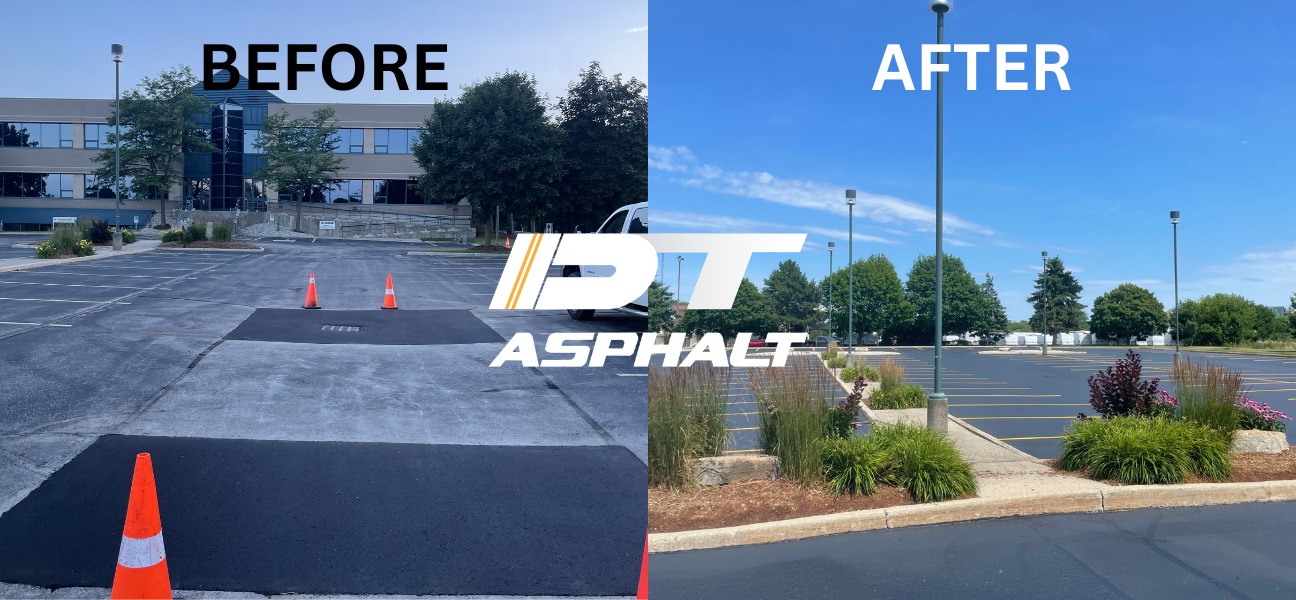
Over time, the work has included catch basin repairs, drainage corrections, crack filling, targeted asphalt repairs, and a properly applied double coat sealcoat with clean striping.
We completed their most recent maintenance cycle in 2025.
Their pavement is not new, but it’s still smooth, safe, and looks like new.
That is what consistent, properly executed maintenance looks like.
.png)
First, you have to understand that not every pavement can be “saved” with maintenance. Some lots are too far gone. If the structure is cooked, no sealer on earth is going to magically turn it back into a healthy pavement. Preventive maintenance is for pavement that still has life left in it. FHWA guidance says this plainly too: if the pavement already has major structural deficiencies, it may no longer be a good candidate for preventive maintenance and may need rehabilitation or reconstruction instead.
That’s where a lot of property managers get burned. They either do nothing too long and miss the preservation window, or they hire someone who sells them a cosmetic fix on pavement that really needed structural repair first.
The right way is much more straightforward.
If the lot is still fundamentally sound, you keep water out, you address failing areas before they spread, and you protect the surface from further oxidation and weathering.

That usually means cleaning properly, sealing active cracks properly, repairing localized failed sections properly, and only then applying the right surface treatment if the pavement condition actually justifies it. Not every lot needs the exact same recipe, and anybody pretending otherwise is selling a one-size-fits-all fairy tale.
This is also where I need to say something that a lot of people in this industry don’t say clearly enough:
Not all sealer is worth doing.
A bad sealcoat job is not “better than nothing.” Sometimes it is just a waste of money with black colour on top.

The broader preservation literature is clear that treatment success depends on timing, material selection, specifications and construction quality. FHWA’s preservation guidance is built around quality materials and quality construction for a reason. Even military and FAA-style seal coat specs spell out approved materials, surface preparation, temperature requirements and application rates, and they explicitly warn against exceeding recommended rates without manufacturer guidance. In other words, the material, the prep, and the application all matter. A guy showing up with a tank and spraying black liquid everywhere is not a preservation strategy.
If the wrong product is used, if the lot isn’t cleaned properly, if cracks are skipped, if the mix is junk, if the application is too heavy, too thin, rushed, tracked or done outside proper conditions, then yes, it can be a complete waste of time and money.
You shorten the life of the asset.
The cracks widen. More water gets in. Freeze-thaw does what freeze-thaw does. Oxidation continues. Weak spots spread. Repairs get larger. Safety complaints go up. Appearance drops. Liability exposure increases. Tenants notice. Owners notice. Visitors notice.

Then eventually you’re no longer discussing maintenance—you’re discussing major repairs, overlay, mill-and-pave, or full reconstruction.
That is where the capital gets ugly.
And this is exactly why property managers should look at pavement the same way they look at any other asset class on a site.
You don’t wait for a roof to cave in before acknowledging it needs attention.
You don’t let a mechanical system run itself into the ground if there’s a cheaper path to keep it operating longer.
Pavement should be treated the same way.
Protect what is still worth protecting.
Repair what actually needs repair.
Don’t waste money on nonsense.

And don’t let people with a direct incentive to sell replacement convince you that preservation doesn’t matter.
Because this is not an afterthought for us.
We are not dabbling in maintenance because paving got slow. This is what we actually study, think about, sell and execute. We understand the difference between cosmetic work and real preservation work. We understand where maintenance makes sense, where structural repair is needed first, and where a client is better off putting money toward bigger rehabilitation instead of pretending a surface treatment will save something that’s already too far gone.
And beyond the education side, we do high quality work.
That matters more than most people realize, because in pavement maintenance the gap between a proper job and a junk job is massive. On paper they can sound similar. In the field they are not even close.
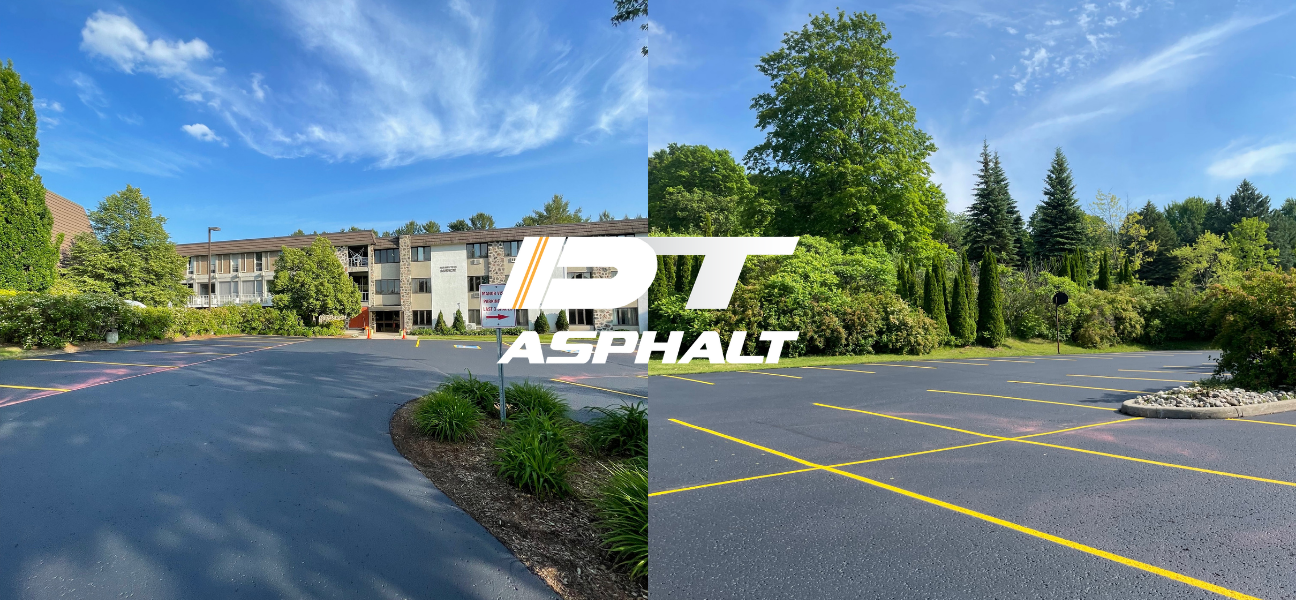
A properly cleaned lot, correctly repaired failures, professionally sealed cracks, quality material applied to spec, sharp edges, clean transitions, consistent finish, proper curing and a final result that actually looks like somebody gave a damn — that is what separates preservation work that builds trust from the kind of job that makes property managers swear off maintenance altogether.
That’s also why social proof matters.
Anybody can talk tough in a quote or brochure. The real proof is in the before and afters, the close-up details, the problem areas that were fixed properly, the commercial sites that now look ten times better, and the clients who can physically see that the lot was treated like an asset instead of a quick paycheque.
At the end of the day, pavement preservation is not complicated, but it is disciplined.
Water gets in, pavement fails.
Oxidation hardens it, pavement cracks.
Traffic loads weakened areas, pavement breaks faster.
If you catch it early and do the right work, you can slow that cycle down and stretch the life of the asset.
If you ignore it, you pay more later.
That’s the whole game.



.png)
